So, recently I watched
Fitzcarraldo by Werner Herzog, and
I had posted some stills from the film, one of my frame-by-frame mini-chronicles much like I did with
The Assassination of Jesse James by the Coward Robert Ford and
Andrei Tarkovsky's Stalker.
I thought it was a good film, filled with some amazing images. And reading up on the production back-story was fascinating as well.
I'm not terribly well acquainted with Herzog's work; his name is thrown around a lot in film-school, he gets rave reviews all the time, but I haven't seen much of his stuff. Why is that?
After watching
Fitzcarraldo (which I'd like to write a post about eventually, I thought about what I do know of Herzog's stuff. I've seen
Fitzcarraldo,
Aguirre the Wrath of God, and Grizzly Man. Of the 3,
Grizzly Man was the first; it's also the only documentary of his I've seen (and he has made a number of documentaries).
------
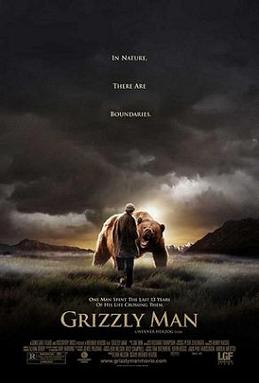
poster for Grizzly Man (2005)
dir. Werner Herzog
I saw it several years ago and remember it fairly well. It left an impression on me, but it's also colored everything I've seen by Herzog since.
In particular, I remember the brief 'Dead Fox Scene.' Timothy Treadwell cries and laments over the corpse of a small fox. "I don't understand," he says, "It's a painful world." Then Herzog's voice-over cuts in:
Here, I differ with Treadwell.
He seemed to ignore the fact that in nature there are predators.
I believe the common denominator of the Universe is not harmony,
but chaos, hostility, and murder.
-- Werner Herzog (in response to Treadwell)
I have to say, especially after sampling a bit more of his oeuvre:
Is Herzog serious?
------
Grizzly Man (2005)
dir. Werner Herzog
[I'd like to point out that the YouTuber, elperfect0, who uploaded this
is more versed in film than I am:]
Taken from Werner Herzog's 2005 documentary 'Grizzly Man'.
The scene is quiet similar to the (in)famous fox scene of Lars von Trier's Antichrist (2009).
"Chaos reigns" - says the fox in Antichrist
------
Now, there's a lot you can say about
Grizzly Man; it's got rave reviews, I usually hear nothing but good stuff about it from my peers who have seen it. And currently, it's a
93% on Rotten Tomatoes (if these things matter). For the most part, I found it interesting as a psychological portrait of Treadwell. Stylistic, it's well designed, very controlled; the story is told well. And Herzog does show genuine compassion and respect to Timothy Treadwell, even as he takes Treadwell as a sort of image or philosophical launching pad. And in it's philosophical pondering, it's at least........
......... amusing.
I can agree that chaos is a common denominator to the Universe; or, at least, I think it's a considerable component to it: change, mutation, impermanence-- these, I think, are general constants. Death too; everything passes away,.
But to suggest "murder" as a Universal denominator is to commit to a tropism. It's mistaking the universe as being of a mind, or rather, of having an intention or direction to its phenomena. From my perspective, we can only fairly speak of Human action being the result of intentionality. Hence, people "murder" other people.
Treadwell comes across as overly idealist and naive, but he and Herzog seem to agree the Universe is one big House of Pain**
Island of Lost Souls (1932)
dir. Erle C. Kenton
based on the novel
The Island of Dr. Moreau by H.G. Wells
Now I understand it's meant to be positing a perspective of things. I get the point: Death and Violence are indeed realities and constants in the world. I agree even: Yes, violence and chaos are constants in life.
However, we should bear in mind that a good amount of the Universe is non-living too; in fact, more of the universe is non-living than can be murdered.
And wouldn't it be convenient if "murder" was all that the universe abides by?
Then something like genocide would only be the universe operating as it should.
Murder is a specifically human invention; genocide is undeniably a human invention. Rwanda or the Holocaust or whatever did not come about because an electron suddenly gained a positive charge. To argue that "murder," "chaos" and "hostility" are the glue which keeps stuff together is damaging; it undermines and dismisses our ability to better anything; it's privileged and spoiled, and, in its own way, revisionistic.
It's not a washing away of sins, but rather pretending no crime been committed.
I guess I'm rambling again.
If this is a review of the film I'll sum up:
The film first explores Treadwell as a complex character, then dresses him up as a figure (or maybe straw-man) for Herzog to ruminate upon. In a sense, it's a dialectical approach which ricochets back and forth between Treadwell's naive back-to-nature, all-is-good view of life and Herzog's equally simplified and extreme brand of nihilism. But you know what you're going into because it's a Herzog picture.
Overall-- 3 out of 5.
Not a 5 star film, above average.
For good, thought-provoking meditation on nihilism,
watch Bladerunner.