Showing posts with label film. Show all posts

Monday, October 14, 2013

"The Face of Garbo" -- Roland Barthes, Mythologies (w/ illustrations)

Greta Garbo from Inspiration (1931)


Garbo still belongs to that moment in cinema when capturing the human face still plunged audiences into the deepest ecstasy, when one literally lost oneself in a human image as one would in a philtre, when the face represented a kind of absolute state of the flesh, which could be neither reacher nor renounced.  A few years earlier the face of Valentino was causing suicides; that of Garbo still partakes of the same rule of Courtly Love, where the flesh gives rise to mystical feelings of perdition.

It is indeed an admirable face-object.  In Queen Christina, a film which has again been shown in Paris in the last few years, the make-up has the snowy thickness of a mask:  it is not a painted face, but one set in plaster, protected by the surface of the colour, not by its lineaments.  Amid all this snow at once fragile and compact, the eyes alone, black like strange soft flesh, but not in the least expressive, are two faintly tremulous wounds.  In spite of its extreme beauty, this face, not drawn but sculpted in something smooth and friable, that is, at once perfect and ephemeral, comes to resemble the flour-white complexion of Charlie Chaplin, the dark vegetation of his eyes, his totem-like countenance.


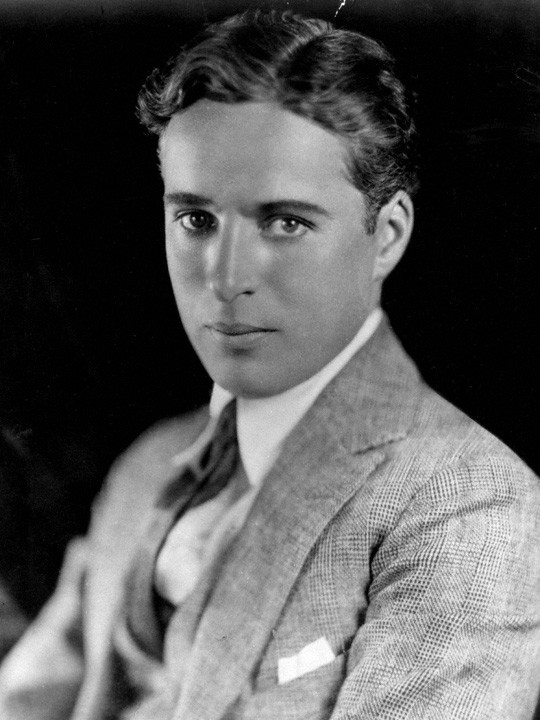
left: Charlie Chaplin as 'The Tramp'
right: Chaplin without any mask or makeup)
(images via wikipedia.org)


Now the temptation of the absolute mask (the mask of antiquity, for instance) perhaps implies less the theme of the secret (as is the case with the Italian half mask) than that of an archetype of the human face.  Garbo offered to one's gaze a sort of Platonic Idea of the human creature, which explains why her face is almost sexually undefined, without however leaving one in doubt.  It is true that this film (in which Queen Christina is by turns a woman and a young cavalier) lends itself to this lack of differentiation; but Garbo does not perform in it any feat of transvestism; she is always herself, and carries without pretence, under her crown or her wide-brimmed hats, the same snowy solitary face.  The name given to her, the Divine, probably aimed to convey less a superlative state of beauty than the essence of her corporeal person, descended from a heaven where all things are formed and perfected in the clearest light.  She herself knew this:  how many actresses have consented to let the crowd see the ominous maturing of their beauty.  Not she, however; the essence was not to be degraded, her face was not to have any reality except that of its perfection, which was intellectual even more than forma.  The Essence became gradually obscured, progressively veiled with dark glasses, broad hats and exiles:  but it never deteriorated.


'AAA_Audrey,' 3D Base-Model 
designed on Audrey Hepburn
available from turbosquid.com
artist credit: AAApoly


And yet, in this deified face, something sharper than a mask is looming:  a kind of voluntary and therefore human relation between the curve of the nostrils and the arch of the eyebrows; a rare, individual function relating two regions of the face.  A mask is but a sum of lines; a face, on the contrary, is above all their thematic harmony.  Garbo's face represents this fragile moment when the cinema is about to draw an existential from an essential beauty, when the archetype leans towards fascination of mortal faces, when the clarity of the flesh as essence yields its place to a lyricism of Woman.

Viewed as a transition the face of Garbo reconciles two iconographic ages, it assures the passage form awe to charm.  As is well known, we are today at the other pole of this evolution:  the face of Audrey Hepburn, for instance, is individualized, not only because of its peculiar thematics (woman as child, woman as kitten) but also because of her person, of an almost unique specification of the face, which has nothing of the essence left in it, but is constituted by an infinite complexity of morphological functions.  As a language, Garbo's singularity was of the order of the concept, that of Audrey Hepburn is of the order of the substance.  The face of Garbo is an idea, that of Hepburn, an Event.


-- Roland Barthes, Mythologies


Barthes, Roland.  "The Face of Garbo."  Mythologies.  Trans.  Annette Lavers.  The Noonday Press, New York:  1992.

Statue of Garbo in her hometown

(image via wikipedia.org)


* * *


* * *

Friday, August 16, 2013

Oldboy -- Spike Lee & Chan-Wook Park -- What's with Hollywood Remakes of Foreign Films?


here's yet another entry into the ever growing canon 
of Hollywood remaking foreign films...
this time, Spike Lee's "re-imagining" of Oldboy...


"Old Boy" (2013)
dir. Spike Lee


Following in the footsteps of David Fincher's The Girl with the Dragon Tattoo, Spike Lee's Oldboy looks like a movie which didn't need to be made & who nobody was asking for.  I'm not sure why it was remade.  The original is pretty popular and well known already.  But, maybe, Americans just have a problem with caring about stuff that's not explicitly American.

Also, American remakes of foreign films always lose significance because they become permanently re-codified with a primarily American perspective on the story.

It's especially odd since Dir. Chan-Wook Park has now released a film through Hollywood--


Stoker (2013)
Dir. Chan-Wook Park

Why rehash Park's story for American audience when he himself has created a new story for American audiences?

To be fair, Spike Lee's Oldboy was delayed... it may have been in production before Park's Stoker began...

In one way, it's a sign of how popular the entity has become.  As with Dragon Tattoo and Let the Right One In, Oldboy has become recognized by Hollywood as a successful & notable franchise.   The greatest compliment is imitation, right?

Apparently, Josh Brolin asked Director Park for his blessing in remaking Oldboy; to which Park replied with something like:  "Don't remake my movie, you and Spike should make your own movie."* sourced.

This was interpreted by Lee & Brolin as "take creative liberties with the project; make it yours"... but it also sounds a lot like "Come up with a new idea guys."

I'm confused how or why Spike Lee became attached to this project?

But I haven't looked very hard for an answer.

I'd rather wait for an original movie.

Sunday, June 23, 2013

Herzog, Nihilsm and "Grizzly Man" -- Dead Fox Scene

So, recently I watched Fitzcarraldo by Werner Herzog, and I had posted some stills from the film, one of my frame-by-frame mini-chronicles much like I did with The Assassination of Jesse James by the Coward Robert Ford and Andrei Tarkovsky's Stalker.

I thought it was a good film, filled with some amazing images. And reading up on the production back-story was fascinating as well.

I'm not terribly well acquainted with Herzog's work; his name is thrown around a lot in film-school, he gets rave reviews all the time, but I haven't seen much of his stuff.  Why is that?

After watching Fitzcarraldo (which I'd like to write a post about eventually, I thought about what I do know of Herzog's stuff.  I've seen Fitzcarraldo, Aguirre the Wrath of God, and Grizzly Man. Of the 3, Grizzly Man was the first; it's also the only documentary of his I've seen (and he has made a number of documentaries).

------
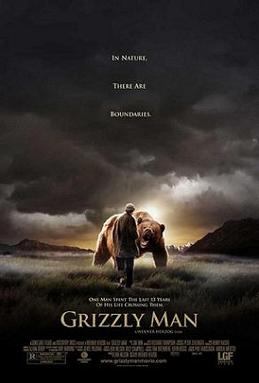
poster for Grizzly Man (2005)
dir. Werner Herzog
( via wikipedia )


I saw it several years ago and remember it fairly well. It left an impression on me, but it's also colored everything I've seen by Herzog since.

In particular, I remember the brief 'Dead Fox Scene.'  Timothy Treadwell cries and laments over the corpse of a small fox.  "I don't understand," he says, "It's a painful world." Then Herzog's voice-over cuts in:

Here, I differ with Treadwell.  
He seemed to ignore the fact that in nature there are predators.
I believe the common denominator of the Universe is not harmony, 
but chaos, hostility, and murder.
-- Werner Herzog (in response to Treadwell)


I have to say, especially after sampling a bit more of his oeuvre: 
Is Herzog serious?

------

Grizzly Man (2005)
dir. Werner Herzog

[I'd like to point out that the YouTuber, elperfect0, who uploaded this
is more versed in film than I am:]


Taken from Werner Herzog's 2005 documentary 'Grizzly Man'. 
The scene is quiet similar to the (in)famous fox scene of Lars von Trier's Antichrist (2009).

"Chaos reigns" - says the fox in Antichrist


------

Now, there's a lot you can say about Grizzly Man; it's got rave reviews, I usually hear nothing but good stuff about it from my peers who have seen it.  And currently, it's a 93% on Rotten Tomatoes (if these things matter).  For the most part, I found it interesting as a psychological portrait of Treadwell.  Stylistic, it's well designed, very controlled; the story is told well.  And Herzog does show genuine compassion and respect to Timothy Treadwell, even as he takes Treadwell as a sort of image or philosophical launching pad. And in it's philosophical pondering, it's at least........
......... amusing.

I can agree that chaos is a common denominator to the Universe; or, at least, I think it's a considerable component to it:  change, mutation, impermanence-- these, I think, are general constants. Death too; everything passes away,.

But to suggest "murder" as a Universal denominator is to commit to a tropism. It's mistaking the universe as being of a mind, or rather, of having an intention or direction to its phenomena. From my perspective, we can only fairly speak of Human action being the result of intentionality. Hence, people "murder" other people.

Treadwell comes across as overly idealist and naive, but he and Herzog seem to agree the Universe is one big House of Pain**


Island of Lost Souls (1932)
dir. Erle C. Kenton
based on the novel 
The Island of Dr. Moreau by H.G. Wells


Now I understand it's meant to be positing a perspective of things.  I get the point:  Death and Violence are indeed realities and constants in the world.  I agree even: Yes, violence and chaos are constants in life

However, we should bear in mind that a good amount of the Universe is non-living too; in fact, more of the universe is non-living than can be murdered.

And wouldn't it be convenient if "murder" was all that the universe abides by?
Then something like genocide would only be the universe operating as it should.

Murder is a specifically human invention; genocide is undeniably a human invention.  Rwanda or the Holocaust or whatever did not come about because an electron suddenly gained a positive charge.  To argue that "murder," "chaos" and "hostility" are the glue which keeps stuff together is damaging; it undermines and dismisses our ability to better anything; it's privileged and spoiled, and, in its own way, revisionistic.

It's not a washing away of sins, but rather pretending no crime been committed.  

I guess I'm rambling again.
If this is a review of the film I'll sum up:

The film first explores Treadwell as a complex character, then dresses him up as a figure (or maybe straw-man) for Herzog to ruminate upon.  In a sense, it's a dialectical approach which ricochets back and forth between Treadwell's naive back-to-nature, all-is-good view of life and Herzog's equally simplified and extreme brand of nihilism. But you know what you're going into because it's a Herzog picture.

Overall--   3 out of 5.
Not a 5 star film, above average.
For good, thought-provoking meditation on nihilism,
watch Bladerunner.

------
** Not to be confused with this House of Pain...

Wednesday, June 12, 2013

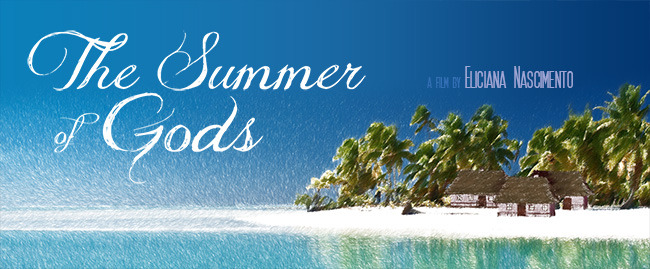
Kickstarter -- "The Summer of Gods" -- SFSU Produced Short Film

A former classmate of mine is beginning production on her thesis film, entitled 'The Summer of Gods.'
She's put together a Kickstarter to raise funds for the project:


The film is a short fantasy piece, inspired by African folklore & mythology, to be shot on location in Brazil.

Eliciana & I took a cinematography class together.  For her final project, she shot some test footage of the FX for her thesis film.  The FX were a blend of digital post production and old school matting, which, I think, is a golden mix for low-budget indie filmmakers.  The images looked promising, and her compositions were well designed too.

Her kickstarter has a brief shout-out from Danny Glover too.  
Wild.

In case you missed it...

Monday, June 10, 2013

"Fitzcarraldo" -- Werner Herzog -- Phonograph + Jungle


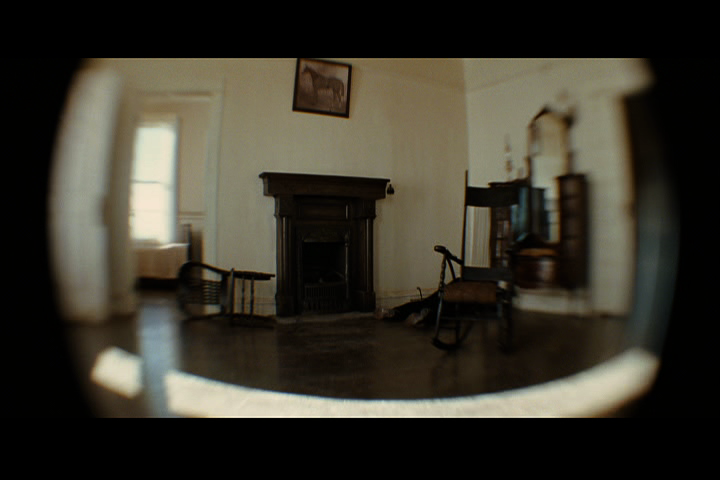
Fitzcarraldo (1982)
dir. Werner Herzog
d.p. Thomas Mauch
with Klaus Kinski

Friday, June 7, 2013

Alternate 'A Scanner Darkly' Pitch -- Ghost Cinema -- Animation

(I found this via the Total Dickhead)


What a different aesthetic than Linklater's adaptation; I really dig it.
Much more surreal and genre inspired.


A Scanner Darkly (2006)
dir. Richard Linklater

Although I have respect for Linklater,
and I think he did a commendable job with Scanner,
the visual style I always was always unsure about.

Why the choice to rotoscope?
And why rotoscope so closely to the real?

I suppose it gives a slightly "unreal" quality to the image all the way across the board, but, at the same time, I wished it were either more real or more stylized.  That might be strange to say, since A Scanner Darkly is one of those Dick novels which avoids planting both feet on the same plane, but I do feel it's the case.

Animation is quite versatile and expressive because each frame can be produced without regard to limitation, save for the trace of the human eye; to confine it to what a human body is capable of is to work against the craft.  At the same time, we never really get to witness the genuine acting or emotions of the actors on screen... which is also unfortunate, because that's what animation doesn't produce: human faces.

Still, the animation in Linklater's Scanner is not quite trying to be real.
It's uncanny, but also not.
It's life trying to be a drawing, which is stranger than a cartoon trying to be real.

Now I'm just babbling.
I'm glad a film was made; it exposed more people to one of PKD's better stories, and did so in a respectful manner.


~ * ~ * ~ * ~ * ~ * ~EDIT / UPDATE * ~ * ~ * ~ * ~ * ~ * ~


JUNE 8th, 2013 UPDATE:
I had meant to cross link to my other post about the CGI Audrey Hepburn ad, but forgot.
So here's the link now:

Wednesday, May 15, 2013

Paranoia 1.0 -- One Point Oh -- trailer


trailer for Paranoia 1.0 (2004)
dir. Jeff Renfroe, Marteinn Thorsson


Saturday, November 10, 2012

"The Assassination of Jesse James by the Coward Robert Ford" (2007)

The Assassination of Jesse James by the Coward Robert Ford (2007)
dir. Andrew Dominik
d.p. Roger Deakins


"Don't that picture look dusty?"
-- Jesse James' final line


Sunday, November 4, 2012

2 candids of Hiro Narita - Cinematography Workshop, SFSU

2 candids I snapped of Hiro Narita during his cinematography demo / workshop at SFSU.


Hiro Narita 
@ SFSU Cinematography Workshop
photos by russ kiel

...could use some color balancing


"The Rocketeer"
dir.  Joe Johnston
d.p. Hiro Narita

Tuesday, October 16, 2012

"The False Mirror" + "Bladerunner"

"The False Mirror" -- Rene Magritte

"Bladerunner" -- dir. Ridley Scott

What is the false mirror? 
Is it the eye? The image of the eye? Perception itself?
Of course, Magritte also plays with windows (i.e. 'The Human Condition') so maybe here, the eye is an extension of his mirror / hole-in-the-wall motif:  the eye is a window is a false mirror; it does not reflect, but opens into the world?

The false mirror does not reflect the world, but ingests it; the exterior becomes interior, and vice-versa.
There is no foreground in this image.  The eye and the sky are both given equal precedence.

And what is a replicant?
A false human?  A false soul?

Thursday, October 4, 2012

"Junkopia" -- Chris Marker

I guess this is roundabout where i live now.


"Junkopia"
dir. Chris Marker
w/ Frank Simeone 
& John Chapman

RIP Chris Marker
(29 July 1921- 29 July 2012)

Sunday, September 30, 2012

Tuesday, September 25, 2012

Fritz Lang's "Metropolis" + NIN's "Tetsuo III: Bulletman theme"

Dangerously close to a week without an update from me.
So here's a link to a video I cut a while back.

(of course you can click it & get the HD version..)


"Metropolis" (1927)
dir. Fritz Lang
"Tetsuo III: The Bulletman theme" 
by Trent Reznor/NIN
video cut by Russ Kiel

Thursday, September 13, 2012

Cesar Velasco Broca -- "Avant Petalos Grillado"


"Avant Petalos Grillado"
dir. Cesar Velasco Broca (2006).